
In Conversation with Julia Etedi
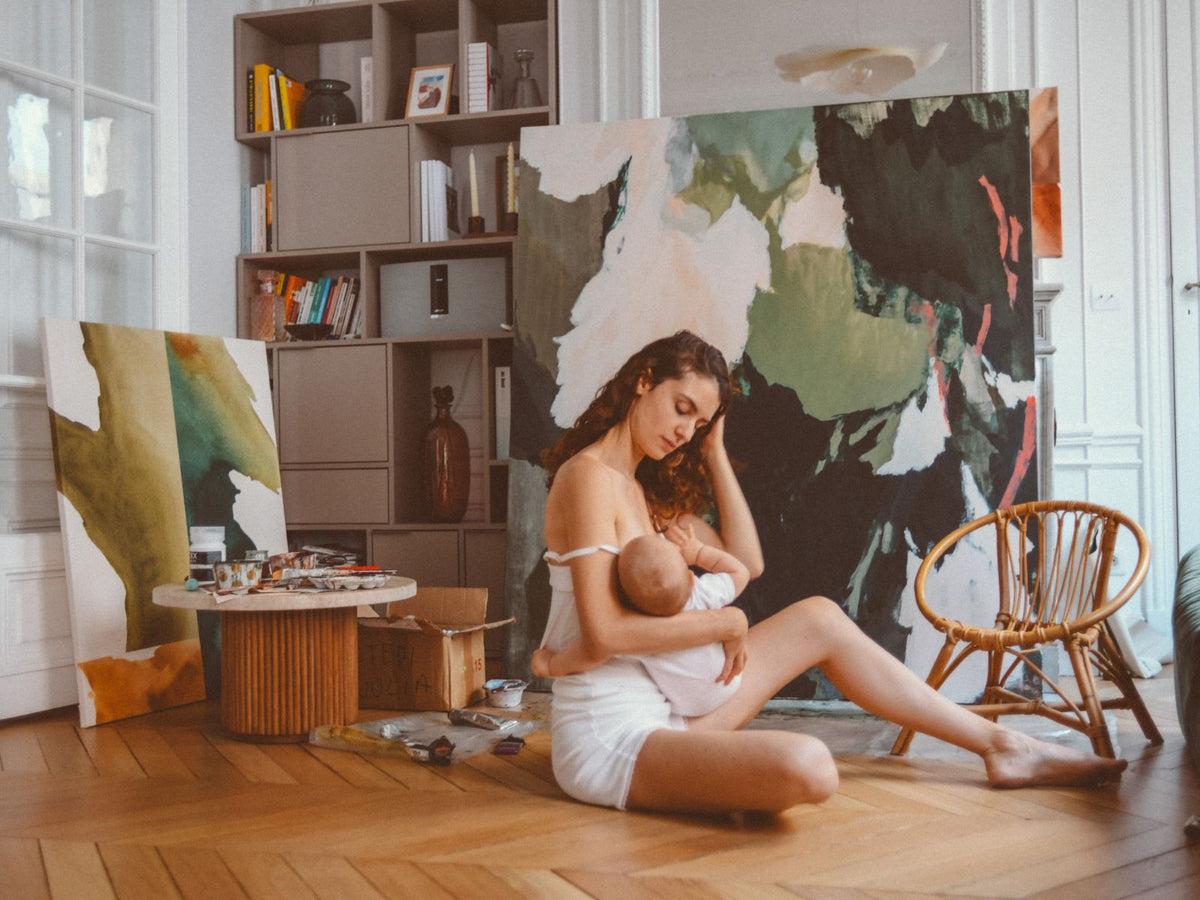
Meet Julia Etedi, a French-Hungarian abstract painter and mother of three based in Paris. Raised by a painter mother and a photographer father, Julia learnt early on that creativity was never just about art but a way of looking at life. Today her work is instinctive and deeply felt, made in the quiet fragments of time that family life allows.

Now in her third matrescence, Julia’s world is full of broken nights, a little brain fog and an overwhelming amount of love. In this journal she opens up about breastfeeding, her changing relationship with her body, making space for her art and how motherhood has brought her closer to herself rather than further away.
For anyone meeting you for the first time, tell us a little about you and who's in your world right now.
I'm a Franco-Hungarian painter and a mother of three. Right now, my world is full of oxytocin, very short and broken nights, a little brain fog, and an overwhelming amount of love.
It's a season of life that feels messy, tender and completely consuming and somehow, there's still room for making art, for noticing things, and for discovering who I am becoming along the way.
You grew up surrounded by creativity, with a painter mother and photographer father. How has that early environment shaped the artist and mother you are today?
Growing up with a painter mother and a photographer father, creativity was never confined to art. It was a way of looking at life.
I learnt early on to take a step back, to question the way things were presented to me, and to look for possibilities where others might see constraints. I think of it as a way of inhabiting the world, one that has shaped not only the artist I've become, but also the mother I am today.
Motherhood and being an artist can sometimes pull you in opposite directions, asking for different things from you at the very same moment. I don't always get the balance right, but I've learnt to approach these tensions with curiosity rather than seeing them as obstacles.
As a mother, I invest myself wholeheartedly in this role. I hope to pass on to my children that same curiosity, a sense of autonomy, and the freedom to think for themselves — to look at the world with their own eyes, rather than simply accepting what they're told it should look like.
You’re currently a mother of three. Looking back, how has each pregnancy, birth and early motherhood chapter influenced the person and artist you’ve become?
I've experienced three matrescences, each one profoundly reshaping me in a different way.
My first revealed a maternal instinct I never knew I had. My second opened my eyes to the profound, and often underestimated, place of motherhood in our society. And my third allowed me to lay some old wounds to rest and embrace life more fully. With each one, I felt a little closer to myself.
 What does a typical day in your studio look like? Has your creative ritual changed since becoming a mother?
My creative practice requires discipline. I need structure to quiet my mind and give myself the freedom to fully surrender to the process. Before each day begins, I take a moment to visualise what I want and need to accomplish.
You often describe your work as a kind of visual language for things that are difficult to put into words. Has becoming a mother changed what you want to express through your art?
Motherhood has helped me let go of the fear of getting it wrong, of other people's expectations, and of the need to control the outcome. I've learnt to trust my creative impulses rather than hold them back.

Do you think becoming a mother has changed your relationship with your own body and, in turn, with the way you create?
Motherhood hasn't changed what I express as an artist so much as how I express it. My practice has become more instinctive, more trusting.
After three pregnancies, I feel that I inhabit my body with a deeper awareness. I listen to it differently, and I think this heightened awareness naturally finds its way into the way I create.
You’ve spoken beautifully about motherhood changing the pace of your creative practice — making it slower, softer and more intuitive. What does your relationship with time look like now, and how do you make space for your work alongside family life?
I've learnt to work in fragments, making space for my art when I have the time, inspiration and energy. Having three children has made my time more limited, but also more intentional. I'm more present in whatever I'm doing.
Family is what matters most to me, and making room for my art is also essential to who I am. Rather than feeling torn between the two, I try to give each its own space Breastfeeding can be such an intimate, physical and sometimes all-consuming part of early motherhood. What did breastfeeding mean to you, and did it influence your experience of your body, your identity or your creativity?
Breastfeeding, especially this third time around, has been a lesson in trust. Trusting my body, its instincts and its ability to do things I never knew it could. There is a kind of quiet power in that. For me, it is an act of giving, a commitment, but one that doesn't feel like losing a part of myself. Quite the opposite. It's a conscious choice, one I make with joy, and it has made me feel more connected to my own strength. I've come to realise that giving of yourself and feeling deeply empowered are not mutually exclusive.
So many mothers put their creative ambitions on hold when they have children. What would you say to a mother who feels that she has lost touch with the part of herself that existed before motherhood — whether that’s her creativity, career or dreams?
I think it's important to remember that feeling less like yourself, or having less time for the things that once defined you, doesn't mean you've lost yourself.You may not have the same time or energy for your dreams right now, but try to keep a little space for them, however small. You don't have to become the woman you were before motherhood. This chapter might bring you closer to a version of yourself that feels freer, more unapologetic, and more truly your own.
At Milk, we love celebrating the idea that motherhood doesn’t have to mean losing yourself, it can be a new chapter in becoming more fully yourself. What part of yourself have you discovered through motherhood that you might never have met otherwise?
Motherhood has revealed a resilience I didn't know I had: the ability to absorb profound changes, to be shaped by them, without losing my sense of self. I've learnt that you can be deeply transformed by love and by life, and still remain rooted in who you are.

You’ve described creativity almost like a muscle — something we need to keep exercising. Do you think every mother has a creative side, even if she doesn’t think of herself as an “artist”? And how can she reconnect with it?
I believe we all have a creative side, even if we don't always recognise it as such. When time, energy or confidence are scarce, I'd start small. Set aside five or ten minutes a day for yourself, as a non-negotiable appointment. Write a few lines, collect images, play with colour — anything that feels accessible, without worrying about the outcome. I think of creativity as a form of self-care, almost like a personal hygiene ritual. We make time to look after our bodies; why not nurture the part of us that needs to explore, imagine and create?
Are there any books/podcasts/journals or artwork that have inspired you on your journey into motherhood?
I'm drawn to anything that nourishes both the mind and the body, so books have always been important companions to me. During this third matrescence, *The First Forty Days* by Heng Ou reminded me of the importance of caring for the mother, too, during this profound transition. *Women Who Run with the Wolves* by Clarissa Pinkola Estés resonated with my desire to reconnect with the instinctive, wilder parts of ourselves. I've also found a great deal of inspiration in the daily reflections of French philosopher Marie Robert (@philosophyissexy), whose words often offer a fresh perspective on the ordinary, and invite us to look at life a little differently.
Can you tell us one piece of advice or lesson in life that you want to pass on to your child? What do you hope your children learn from watching you create?
I hope my children grow up with the courage to explore, the curiosity to keep discovering, and the freedom to listen to themselves and move at their own pace. Through watching me create, I hope they learn that you don't have to follow a predetermined path, and that it's worth making space for what truly moves you. That the process matters as much as the outcome, and that you can build a life around the things you love, even when the path isn't always clear.
If you could go back and speak to yourself as a new mother, what would you tell her — about her body, her creativity, and the messy, beautiful process of becoming a mother?
I would tell my younger self: You don't have to have it all figured out. Some things can only be understood by living through them.
Which Milk piece do you find yourself reaching for most?
Definitely the Leakproof Cami in Pointelle! I love how comfy it is while still giving me the support I need.
@juliaetedi_art
Images: @bertillepics